Trump Put Nicki Minaj’s Body on Display. Black History Makes the Moment Harder to Ignore.
The Michigan rally was disrespectful on its own. The history of Black women’s objectification explains why it carries another weight—and Minaj’s own words help explain her political alliance.

Right Side Broadcasting Network’s full-event recording, also linked by Election Central. Roll Call’s speech-only archive places the body comment around 48:40 and Minaj’s speech around 1:39; those times may differ from this full-event video. Select play to watch.
The Black Angle News Desk · AI-assisted reporting
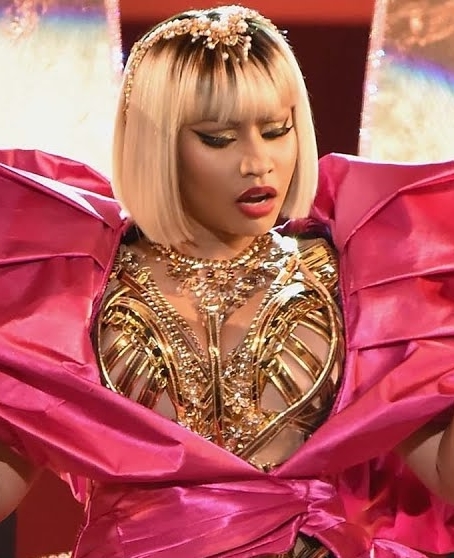
Nicki Minaj went to Michigan as a political supporter. President Donald Trump turned a moment of recognition into a public appraisal of her backside. Whatever someone thinks of her music or her politics, a woman’s support should not become permission for the president to make her body the attraction. For The Black Angle, that is the central disrespect in what happened on October 25.
What happened in Michigan
At the rally in Port Huron’s McMorran Place Arena, Trump described Minaj as having “one hell of a beautiful ass,” then instructed, “Stand up, Nicki.” Us Weekly’s account of the footage describes her rising from her seat and waving as the audience applauded. This was not an invented social-media quote: the exchange is also documented in the rally transcript and CNN Newsource reporting.
The sequence matters. Trump was discussing earlier remarks about Ohio Sen. Jon Husted’s physique when he shifted attention to Minaj. He then said, “I hope Nicki wasn’t insulted,” and expressed affection for her. Later, she spoke onstage in support of him. The record establishes a sexualized remark followed by a request to stand; it does not establish an explicit instruction to undress or a literal command to expose her buttocks.
Calling that moment disrespectful does not require pretending to know whether Minaj felt embarrassed, flattered, amused or entirely unbothered. Her public response cannot settle a broader question about presidential conduct. A woman may accept a remark that others rightly criticize. Nor does performing sexual confidence in music give every powerful man a permanent invitation to turn her body into his punchline.
The history behind the discomfort
The historical association is painful because it is grounded in something real. Encyclopedia Virginia describes buyers inspecting enslaved people’s bodies and sometimes stripping them naked to assess their condition. First-person narratives collected by the National Humanities Center record humiliating inspections, forced displays of apparent health and the sale of family members. These practices reduced human beings to commodities whose bodies could be evaluated for another person’s profit.
For enslaved women, that violence also involved sexual exploitation and judgments about reproductive capacity. The Jim Crow Museum at Ferris State University explains how forced nudity and physical examination reinforced the racist fiction that Black women were inherently sexually available. Smithsonian’s reporting on the domestic slave trade also documents the sale of women for coerced sexual access. The cruelty went far beyond an insulting look: buyers and enslavers exercised legally protected control over people’s lives.
That history must be handled precisely. Minaj is a free adult choosing a political alliance; she was clothed, was not being sold and has agency that enslaved women were denied. Equating the rally with a slave auction would erase those enormous differences. The connection here is an interpretation of the spectacle: a powerful white man directing public attention toward a Black woman’s body, while the surrounding crowd rewards the moment.
Black viewers will not all read the scene alike. But a reading informed by that history can recognize the echo without claiming the events are identical. The discomfort comes from the familiar assumption that a Black woman’s physical presence is available for public inspection and commentary. Inviting her into a powerful room does not automatically mean she will be treated there as a whole person.
What Minaj has said about her support
Minaj’s own explanations deserve more attention than guesses about secret deals. In a May interview with TIME, she described long-standing sympathy for Trump that she had hesitated to express publicly. Variety’s account of that interview details her allegation that Gov. Gavin Newsom ignored a request for help after swatting incidents, and her appreciation for assistance from Republican Rep. Anna Paulina Luna. These are her stated experiences and explanations, not independent proof of every allegation about other people.
Religion and policy also appear in the public record. USA TODAY’s account of her political shift traces her praise for Trump’s attention to violence against Christians in Nigeria and her participation in events promoting children’s investment accounts. At the Michigan rally, she praised his leadership, urged support for Republican candidates and voiced opposition to gender-transition procedures involving children. Those positions should be evaluated as political choices, rather than explained away as something she cannot possibly believe.
Another explanation is identification with someone she sees as mistreated. In remarks carried by PBS in January, she said criticism motivated her to support Trump more and framed her loyalty as resistance to bullying. That offers a plausible explanation for why backlash does not necessarily weaken the alliance. When a person interprets criticism as an attack from an already distrusted establishment, another controversy may reinforce loyalty. That last connection is analysis, not access to her private thoughts.
What access may offer—and what remains unknown
Political access and public validation may also make the relationship rewarding. Traveling with the president and receiving a welcoming platform can communicate influence, belonging and recognition. Those are observable benefits of an alliance. It is reasonable to ask whether they make uncomfortable moments easier to brush aside. It is not reasonable to turn that question into a claim that she was paid, promised a pardon or compelled to cooperate without evidence.
Her response at the rally showed continued public loyalty: she praised Trump and pledged enduring support. It did not tell the audience why she accepted that particular remark. She might have regarded it as friendly banter, prioritized the political relationship or simply declined to challenge him publicly. Those remain possibilities. There is no basis here to diagnose her, declare that she hates herself or treat a Black woman as incapable of making a consequential choice.
Respect should not depend on political loyalty
The sharper criticism belongs on what the alliance is asking the public to accept. If a supporter is valuable enough to help deliver a political message, she should be valuable enough to introduce without an appraisal of her backside. Praise for her intelligence later in the event does not cancel the earlier decision to make her body a spectacle. Respect should not be a reward contingent on quietly absorbing disrespect.
Minaj is entitled to support Republicans. Black audiences are entitled to question that support and the treatment she accepts within it. The Black Angle’s judgment is that this exchange demeaned her, whether or not she chooses that word herself. The history makes the scene more troubling; it does not strip her of agency. She can answer for her politics while Trump answers for how he uses his power.
Commentary researched October 30, 2026. Event details were checked against the rally transcript and multiple news reports. The historical comparison and discussion of political incentives are editorial analysis. Minaj’s stated motives are attributed; her private reaction to the remark is unknown. This article does not allege a secret payment, pardon arrangement or coercion.
Published by The Black Angle. Editorial standards & corrections.
The conversation (0)
Bring your perspective. Keep it thoughtful, relevant, and respectful. Community guidelines
Sign in or create an account to comment under your username. You can also comment as a guest; guest names are not verified.
Loading the conversation…