Oakland names three downtown blocks ‘Black Panther Party Boulevard’
The commemorative name covers Broadway from 14th to 17th streets and arrives as organizers gather in Oakland for the Black Panther Party’s 60th anniversary.
The Black Angle News Desk · AI-assisted reporting
Oakland is placing the Black Panther Party’s name in the center of the city where the movement began. The City Council approved a resolution on October 6 commemoratively naming Broadway between 14th and 17th streets “Black Panther Party Boulevard,” a three-block stretch in downtown Oakland. Plaques are planned at Broadway’s intersections with 14th, 15th and 17th streets.
A name placed in the center of downtown
The designation does not rename every address along Broadway. It adds an honorary name to a limited section whose geography already carries Panther history into the present. The Black Panther Party Museum is located at 1427 Broadway, within the designated stretch, and the Dr. Huey P. Newton Foundation has used the space to preserve artifacts and teach a history that is often reduced to photographs of leather jackets, raised fists and armed patrols.
A public gathering is scheduled for 11:30 a.m. Saturday, October 17, at 15th Street and Broadway, followed by the commemorative unveiling. The ceremony is part of four days of 60th-anniversary programming running October 15 through 18. Organizers have planned panels, workshops, cultural events, a marketplace and a gala across downtown venues, with sponsored access for 1,000 high-school students.
The story is larger than the Panthers’ most famous image
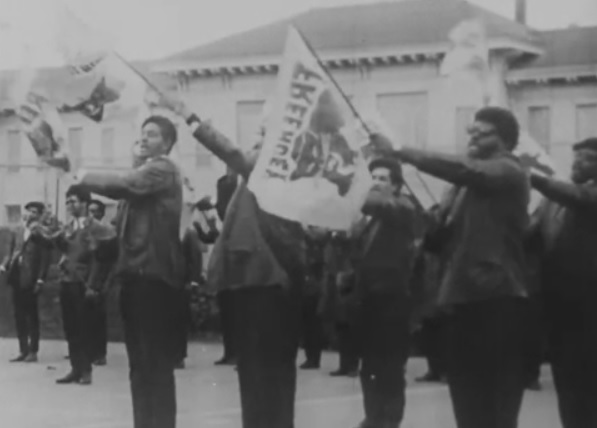
That student access is more than an anniversary detail. It makes the commemoration an invitation to study what the Black Panther Party tried to build, what it endured and where it fell short. Huey P. Newton and Bobby Seale founded the organization in Oakland in October 1966, responding to police violence and the material neglect surrounding Black neighborhoods. Armed monitoring of police became its most recognizable tactic, but it was not the whole program.
The Panthers’ community work included free breakfasts for children, health clinics, sickle-cell anemia testing, political education and transportation for families visiting incarcerated loved ones. Those “survival programs” addressed immediate needs while arguing that food, health care, housing and safety were political rights. The federal government also treated the party as a major threat: surveillance, infiltration, prosecutions and violence helped weaken the organization, alongside internal conflict and strategic divisions.
Remembering both realities matters. Turning the Panthers into only an image of militancy hides the children who ate before school and the neighbors who received basic medical care. Turning the party into uncomplicated legend would erase difficult questions about power, gender, internal discipline and political strategy. A public marker cannot settle those arguments, but it can create a visible place where Oakland residents and visitors encounter them.
A marker in a changing Black city
The downtown location also connects movement history to the city’s changing present. Oakland has repeatedly watched Black residents, institutions and small businesses displaced by rising costs even as the city’s Black political and cultural legacy is marketed widely. An honorary street name is not a housing policy or an economic repair program. Its value depends partly on whether remembrance is matched by support for the people and institutions still carrying that legacy.
Fredrika Newton, who co-founded the Dr. Huey P. Newton Foundation, has described the designation as an enduring tribute to the party’s service and sacrifice. Her role also makes the commemoration intergenerational: the foundation has spent decades collecting, interpreting and defending a history created by people who were often criminalized while alive and simplified after death.
What the designation can carry forward
For Oakland, “Black Panther Party Boulevard” puts official recognition on a route people can walk. It marks the blocks around a living museum, gives the 60th anniversary a permanent civic reference point and asks the city to remember the Panthers as organizers rooted in local conditions—not distant symbols detached from the Black communities they sought to serve. The plaques will be small. The history they point toward is not.
The council action is documented in Oakland’s legislative record and independently reported. The October 17 ribbon cutting had not occurred at publication time, so ceremony details remain subject to organizer changes.
Published by The Black Angle. Editorial standards & corrections.
The conversation (0)
Bring your perspective. Keep it thoughtful, relevant, and respectful. Community guidelines
Sign in or create an account to comment under your username. You can also comment as a guest; guest names are not verified.
Loading the conversation…