Jay-Z’s two SoFi nights turned legacy into a family-and-coast conversation
Blue Ivy and Scarface shaped Friday’s show; Dr. Dre, Snoop Dogg and Too $hort shifted Saturday’s finale toward West Coast history.
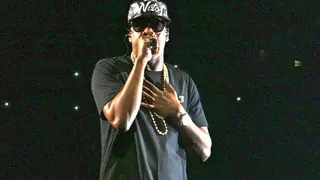
Live Nation’s official October 25 post shows Dr. Dre and Snoop Dogg bringing a West Coast medley to Jay-Z’s second SoFi Stadium concert. Video credit: Live Nation.
The Black Angle News Desk · AI-assisted reporting
Jay-Z closed his two-night SoFi Stadium run on October 24 by turning the stage toward California. Too $hort appeared for ‘Blow the Whistle,’ while Dr. Dre and Snoop Dogg joined a West Coast sequence that included ‘Murder Was the Case,’ ‘The Next Episode,’ ‘California Love,’ ‘Nuthin’ but a ‘G’ Thang’ and ‘Still D.R.E.’ The finale completed a weekend whose first night had emphasized family, mentorship and remembrance through Blue Ivy Carter, Scarface, John Legend, DJ Khaled and music by the late Nipsey Hussle.
Two nights, two ways of framing a catalog
The paired concerts were the Los Angeles finish to the JAŸ-Z30 anniversary series, marking 30 years since ‘Reasonable Doubt’ and 25 years since ‘The Blueprint.’ Both nights moved across Jay-Z’s catalog rather than recreating one album in order. The result was less a museum display than a changing argument about what a three-decade hip-hop legacy can hold: personal history on Friday, then regional exchange on Saturday.
Friday makes the timeline personal
The October 23 opener established the intimate half of that argument. Blue Ivy played piano during ‘The Story of O.J.’ and ‘Dead Presidents,’ then embraced her father before leaving the stage. Scarface joined ‘This Can’t Be Life’ and the Geto Boys’ ‘Mind Playing Tricks on Me.’ John Legend and DJ Khaled later appeared for ‘God Did.’ Each guest represented a different relationship to Jay-Z’s career—family, influence and collaboration—without reducing the night to a conventional anniversary roll call.
Blue Ivy’s appearance made the timeline generational. The 14-year-old had also played during ‘Feelin’ It’ at Yankee Stadium in July, after performing as a dancer on Beyoncé’s ‘Renaissance’ and ‘Cowboy Carter’ tours. Jay-Z has described her as a musician who teaches herself songs by ear. At SoFi, the point was not simply that a famous child appeared beside a famous parent; she participated in the musical architecture of records made years before she was born.
External video shared by Variety shows Blue Ivy Carter playing piano beside Jay-Z during the October 23 concert. The original post date was not independently verified.
Saturday turns toward the West Coast
Saturday changed the map. Too $hort brought Oakland into an Inglewood stadium before Dre and Snoop reframed the middle of Jay-Z’s set around Los Angeles rap history. Their run of songs reached from early-1990s G-funk through ‘Still D.R.E.,’ placing Jay-Z’s New York catalog beside records that helped define the West Coast’s commercial and artistic power. It was a deliberate closing gesture in a city whose rap identity could not be treated as scenery.
The location carried its own memory. SoFi hosted the 2022 Super Bowl halftime show led by Dre and Snoop alongside Mary J. Blige, Kendrick Lamar and Eminem, with 50 Cent appearing as a surprise guest. Four years later, Dre and Snoop returned to the building on Jay-Z’s stage. That did not make Saturday a replay of the halftime show; it turned the stadium into a meeting place for artists whose catalogs helped move hip-hop from regional power centers to the center of American stadium culture.
Nipsey Hussle remains the bridge
Nipsey Hussle remained the weekend’s clearest bridge to Los Angeles. Jay-Z worked ‘Hussle & Motivate’ into ‘Hard Knock Life’ and folded ‘Last Time That I Checc’d’ into ‘On to the Next One.’ Those choices altered his own records so the host city could hear itself inside the retrospective. The connection also had history: Jay-Z contributed a letter to Nipsey’s 2019 memorial and later appeared with him on ‘What It Feels Like’ for the ‘Judas and the Black Messiah’ soundtrack.
The family’s response
That tribute now has a public response from Nipsey’s family. In an October 27 on-camera interview, his brother Blacc Sam called the gesture ‘monumental’ and said Jay-Z had supported Nipsey, their family and their businesses in ways the public may not know. Sam’s account adds something the stage itself could not: the people closest to Nipsey experienced the tribute as part of a longer relationship, not a one-night use of his image and music.
In TMZ’s on-camera interview, Nipsey Hussle’s brother Blacc Sam describes Jay-Z’s SoFi tribute as a meaningful acknowledgment of a relationship that extended beyond music. Video credit: TMZ.
Legacy as a network, not a trophy case
The Black Angle’s interpretation is that the two nights formed a stronger story together than either guest list did alone. Friday narrowed the stadium to a father watching his daughter play and to veteran writers recognizing one another. Saturday widened the frame to a coast and a lineage. The transition kept the anniversary from suggesting that longevity belongs to one person; Jay-Z’s endurance became legible through the people, places and musical traditions connected to it.
That reading should not turn every cameo into evidence of a grand plan. The shows were still hit-heavy spectacles, and the published set list warns that its sequence may be incomplete or out of order. The weekend also did not confirm persistent reports about a future Super Bowl performance or announce new music. What it did establish was visible onstage: a catalog large enough to carry two stadium nights, and an artist willing to let family, peers and another coast reshape the meaning of the celebration.
The first night asked how a legacy travels through family and memory. The second answered with geography—Too $hort, Dre, Snoop and Nipsey’s music positioning California as a participant rather than a backdrop. Together, the concerts made a case that hip-hop history is not a single-city victory lap. It is a network of debts, collaborations and local audiences that keep old records alive by hearing them against new circumstances.
A closing argument about online narratives
During Saturday’s closer, Jay-Z also answered online claims about low resale prices, attendance and the quality of the show. He told the crowd to trust what they could see and hear, then urged them to ‘question everything in this world of AI.’ The intervention turned the last minutes of the tour into a media-literacy argument as well as a victory lap.
The limitation matters: Jay-Z did not identify a specific post as synthetic or provide evidence that the disputed narratives were generated by artificial intelligence. The verified development is his onstage response to criticism—not proof about the origin of every claim. That distinction keeps a legitimate warning about manipulation from becoming another unsupported online assertion.
Live Nation’s October 24 set list warns that its running order may be incomplete or out of sequence. Blacc Sam’s remarks come from TMZ’s direct on-camera interview; the private support he described is not otherwise documented here. Jay-Z challenged online attendance and quality claims from the stage but did not identify specific AI-generated posts or establish their origin.
Published by The Black Angle. Editorial standards & corrections.
The conversation (0)
Bring your perspective. Keep it thoughtful, relevant, and respectful. Community guidelines
Sign in or create an account to comment under your username. You can also comment as a guest; guest names are not verified.
Loading the conversation…