John Legend and Pharrell’s ‘Muse’ asks a familiar voice to sing differently
Their first full album together gives Legend’s voice a new rhythmic frame while drawing gospel, soul, funk, Afrobeat and hip-hop into one 42-minute conversation.

The official Paul Hunter-directed video, released on John Legend’s channel September 25, pairs Legend and the Hollywood Cinematic Orchestra with a cinematic story about inequality, loss and resilience. It is a constructed music video, not documentary reporting.
The Black Angle News Desk · AI-assisted reporting
John Legend’s new album, ‘Muse,’ begins with a reunion that took more than two decades to become a full partnership. Pharrell Williams produced and co-wrote all 16 tracks, giving Legend’s baritone a 42-minute setting that moves through gospel, soul, funk, Afrobeat and hip-hop. The album is now streaming through John Legend Music and Republic Records, and it is the first complete project the two artists have made together.
A collaboration sparked by Clipse
The collaboration did not start as a nostalgia exercise. It grew out of Legend’s chorus on Clipse’s 2025 song ‘The Birds Don’t Sing.’ Pharrell heard another possibility in a voice audiences often associate with piano ballads and proposed a larger project. Most of ‘Muse’ was then written and recorded at Pharrell’s studio inside Louis Vuitton’s Paris headquarters, a location that matches the record’s polished, widescreen ambition without explaining its musical core.
Pharrell changes the vocal posture
That core is a producer asking an established singer to loosen the habits that made him successful. In an Associated Press interview, Legend said Pharrell encouraged him to use a more conversational, talk-sung delivery on selected songs. ‘Fireflies’ makes that shift easy to hear: instead of treating every phrase as a vocal climax, Legend lets the verses carry the cadence of testimony before the melody opens around him.
The choice matters because restraint can be as revealing as range. Legend has spent years proving that he can command a ballad, a choir and a major awards stage. ‘Muse’ is more interested in what happens when that authority is placed inside Pharrell’s rhythmic instincts. The title track, ‘Her’ and ‘Are You OK?’ feature Pharrell directly, while songs such as ‘Daylight’ and ‘Get Back’ test how Legend’s warmth sits against a more percussive frame.
Black music as a living network
The album’s palette also treats Black music as a living network rather than a row of separate genres. Official notes point to Nina Simone, Nat King Cole and Marvin Gaye as touchstones, but the track sequence does not simply recreate an older era. ‘Bodies on the Floor’ brings Clipse back into the story after a brief ‘Taps’ introduction; ‘Fireflies’ links orchestral scale to memories of inequality and survival; and the record’s Afrobeat and hip-hop turns keep its classic-soul language from becoming a museum piece.
That is the most useful way to understand the phrase ‘Black James Bond aesthetic’ that surrounded the rollout. The idea is not only tuxedos, strings or cinematic polish. It is an attempt to let Black romance, danger, grief and elegance occupy the same frame without asking one mood to represent the whole experience. Legend’s voice supplies continuity, while Pharrell keeps changing the room around it.
‘Fireflies’ brings social memory into the frame
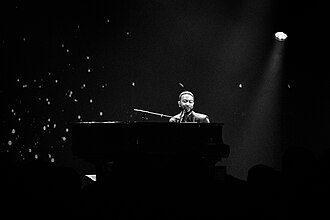
‘Fireflies’ provides the clearest social counterweight to the luxury surrounding the sessions. The Paul Hunter-directed video places Legend at a piano with the Hollywood Cinematic Orchestra and moves through a cinematic housing-project setting. The song’s attention to hardship and getting away complicates any easy reading of ‘Muse’ as only a lovers’ record. Beauty here is not an escape from pressure; it is one way of naming what people carry through it.
Legend’s creative independence is part of the story too. He told the AP that a full album with another producer would not have made sense early in his career, when Kanye West was deeply involved in his GOOD Music projects. He described himself now as more of a free agent, with room from Republic to follow a new collaborator’s ideas. That freedom does not erase his history. It allows him to revisit the formula from a position of choice rather than react against it.
The Black Angle: productive interruption
Our read: ‘Muse’ is strongest as a study in productive interruption. Pharrell does not replace the qualities people recognize in Legend; he presses against their most predictable presentation. Legend, in turn, gives Pharrell a voice capable of connecting the studio’s futuristic polish to traditions that stretch from gospel testimony to orchestral soul. Their friendship may be old, but the album earns its existence by making both artists negotiate something new.
Release-day praise and a prominent guest list cannot determine whether these songs will last. There are no first-week sales or chart results yet, and the album’s full critical life is only beginning. What can be established now is more interesting than a premature verdict: two major Black musicians used trust, autonomy and a shared knowledge of musical history to challenge a familiar voice instead of merely celebrating it.
The album was live on Apple Music and John Legend’s official site on October 23. Track count, running time, collaborators and video credits were checked against primary listings and original interview reporting. No first-week sales or chart results existed at publication, and the interpretive passages are identified as analysis.
Published by The Black Angle. Editorial standards & corrections.
The conversation (0)
Bring your perspective. Keep it thoughtful, relevant, and respectful. Community guidelines
Sign in or create an account to comment under your username. You can also comment as a guest; guest names are not verified.
Loading the conversation…