DHS says ICE will not target polling sites as Black-voter groups prepare
Federal officials say immigration agents will not broadly patrol polling places, while civil-rights groups organize trained observers and legal support for communities concerned about intimidation.
The Black Angle News Desk · AI-assisted reporting
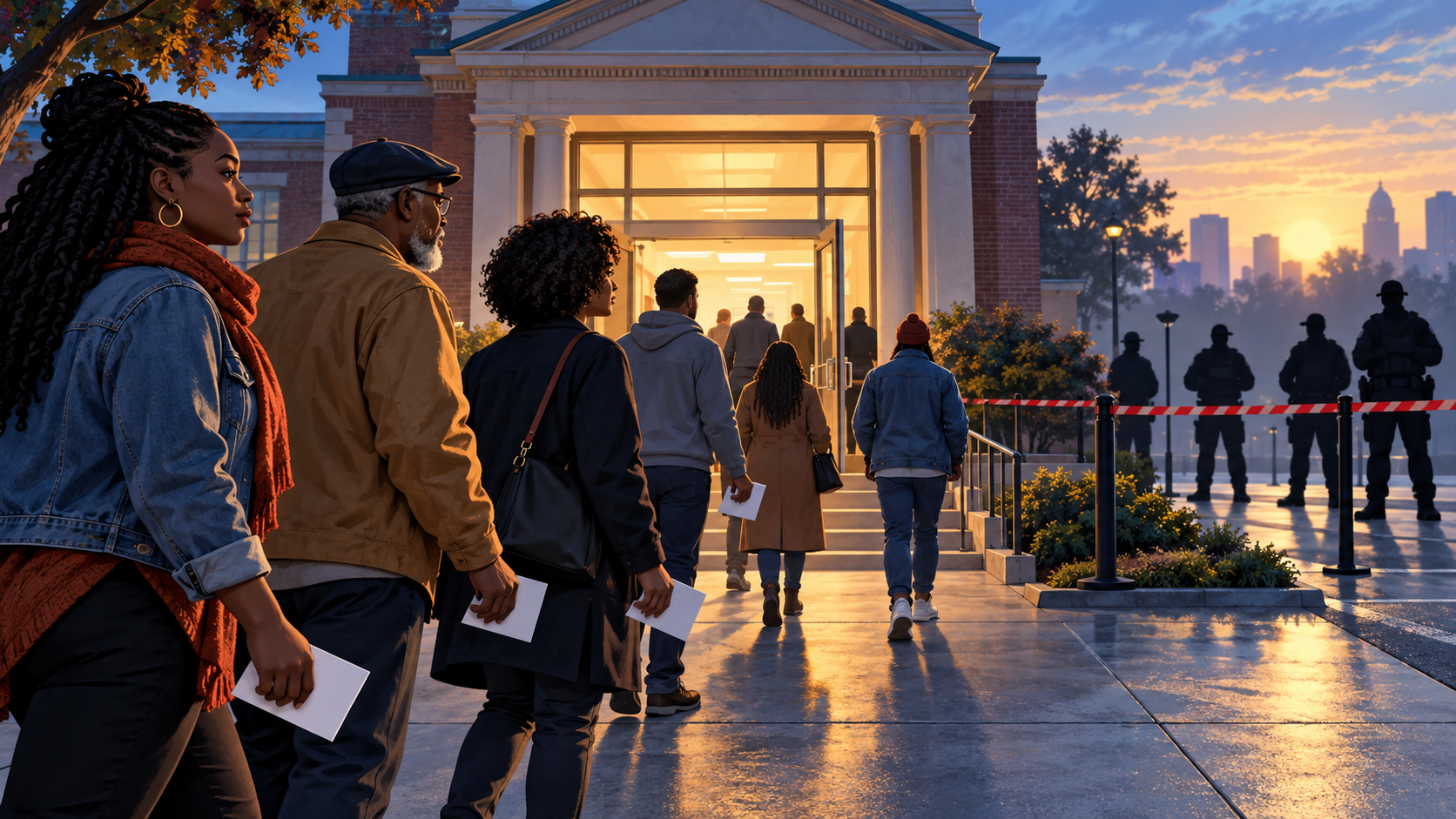
The Department of Homeland Security says Immigration and Customs Enforcement will not conduct operations targeting polling locations during the 2026 midterm election, even as organizations representing Black, Latino and Asian American voters prepare for the possibility that federal agents or rumors about them could discourage people from voting.
In a statement provided to the Associated Press, DHS said ICE is not planning operations aimed at polling sites and described its enforcement as intelligence-driven and targeted. The department left open a narrow possibility that agents could respond if an active public-safety threat endangered a polling place. Earlier in the year, a DHS election-integrity official told state election administrators that ICE would not be present at polling locations, while a department official separately told Reuters that agents might appear only if a specific threat required targeted action.
Those assurances have not fully ended the concern because other public statements have been less definitive. President Donald Trump has not announced a plan to deploy ICE to polling places, but he has also declined to rule out federal action. DHS Secretary Markwayne Mullin has said agents are not intended to patrol or broadly monitor voting sites, while allowing that they might serve a warrant or respond to a threat. Advocacy groups say the distinction matters because even an isolated enforcement action—or an inaccurate social-media report about one—could spread quickly and make lawful voters question whether it is safe to cast a ballot.
What federal law says
Federal law sharply limits the use of armed federal personnel where voting takes place. Section 592 of Title 18 makes it a crime for a federal official to bring or keep troops or armed personnel at an election site unless they are needed to repel armed enemies of the United States. Election-law specialists cited in current reporting say that standard leaves no room for routine patrols or ordinary immigration enforcement at the polls. The Brennan Center for Justice also points to federal civil-rights laws that prohibit voter intimidation and allow affected voters or election workers to seek court intervention.
There is no public evidence that DHS is planning a broad Election Day deployment. That is an important limit on what can responsibly be said. The immediate story is a conflict between the administration’s formal assurance and the fear created by months of aggressive immigration enforcement, political rhetoric and uncertainty about rare targeted actions. Reporting the concern should not turn an unconfirmed deployment into a fact—or amplify rumors that could themselves suppress turnout.
Community groups prepare without escalating
Community organizations are responding with preparation rather than panic. The Vote Safe project, backed by groups including the National Action Network, the American Federation of Teachers and the Save America Movement, plans to place trained, unarmed observers around heavily minority precincts in the Detroit, Atlanta, Cleveland and Charlotte areas. Organizers have said volunteers will include faith leaders, teachers, veterans and firefighters trained in local election law and de-escalation. Their stated goal is to give voters confidence and a familiar point of contact, not to confront law enforcement or interfere with election workers.
The focus on communities of color reflects a practical concern about who may be most affected by the atmosphere around immigration enforcement. Black voters are not subject to immigration checks simply because they vote, and every eligible citizen has the same right to cast a ballot free from intimidation. But mixed-status families, naturalized citizens and people who have seen aggressive enforcement in their neighborhoods may weigh risks differently. Civil-rights organizations argue that trusted local messengers can help separate verified information from fear and keep lawful voters from being pushed out of the process.
Election officials are also preparing response plans. Local administrators have said poll workers can contact election authorities and local law enforcement if an unauthorized armed presence disrupts voting. Courts can consider emergency requests when intimidation or interference threatens access. These safeguards do not guarantee that every dispute will be simple, but they mean voters and poll workers do not have to resolve a confrontation themselves.
What voters can do
For voters, the clearest guidance is to rely on election officials and verified legal-support channels. The Brennan Center advises people not to confront suspected agents and not to broadcast an unverified sighting that could cause unnecessary panic. Voters can alert a poll worker and contact the nonpartisan Election Protection hotline at 866-OUR-VOTE if they encounter conduct that appears intimidating or obstructive. Early voting and mail options vary by state, so checking registration and voting plans through an official state or local election office remains the most reliable preparation.
The administration’s current position is that ICE will not target polling places. Civil-rights groups are organizing in case reality departs from that assurance or misinformation creates a deterrent of its own. The standard should remain straightforward: eligible voters must be able to participate without intimidation, and any enforcement claim near a polling site should be verified before it is repeated.
No public evidence shows a planned broad ICE deployment at polling places. DHS rules out operations targeting voting sites but leaves open rare targeted action tied to a specific public-safety threat.
Published by The Black Angle. Editorial standards & corrections.
The conversation (0)
Bring your perspective. Keep it thoughtful, relevant, and respectful. Community guidelines
Sign in or create an account to comment under your username. You can also comment as a guest; guest names are not verified.
Loading the conversation…